Electric vehicles have moved from early adoption to everyday reality. But one concern keeps surfacing. Range predictability.
Not just how far an EV can go, but why that number changes from one drive to the next. Most drivers understand that weather affects range. Fewer realize that the road itself plays a critical role. What happens beneath the tires has a direct impact on energy use, efficiency, and ultimately how far a vehicle can go.
This is where things start to shift. When road conditions are understood in real time, that uncertainty can be turned into accurate, data-driven optimization.
What actually affects EV range in real conditions
Weather is a key part of the equation.
Weather affects EV range by reducing battery efficiency and increasing rolling resistance through changes in road surface conditions.
Cold air reduces battery performance and increases aerodynamic drag. But just as importantly, weather transforms the road itself.
A dry, smooth road allows an EV to move efficiently. Energy loss is limited, and regenerative braking performs as expected.
As conditions change, resistance builds.
Think about what happens when:
- Rain creates a thin layer of water between tire and asphalt
- Snow and slush compress and deform under the tire
- Ice reduces grip and limits energy recovery
- Rough or worn pavement adds constant resistance
All of this increases rolling resistance.
For electric vehicles, rolling resistance has a direct and immediate impact on energy consumption. More resistance means more torque is required to maintain speed, and less energy can be recovered efficiently.
This is not theoretical. Data from testing and real-world driving shows clear patterns:
- Wet roads increase energy consumption
- Snow and slush can significantly increase resistance
- Rough asphalt consistently consumes more energy than smooth surfaces
That is why range reductions of 10 to 30 percent are common in winter conditions. Not only because of the battery, but because the road itself becomes more energy demanding.
And yet, most vehicles still treat the road as if it were constant.
From estimation to awareness: optimizing EV range with real-time road data
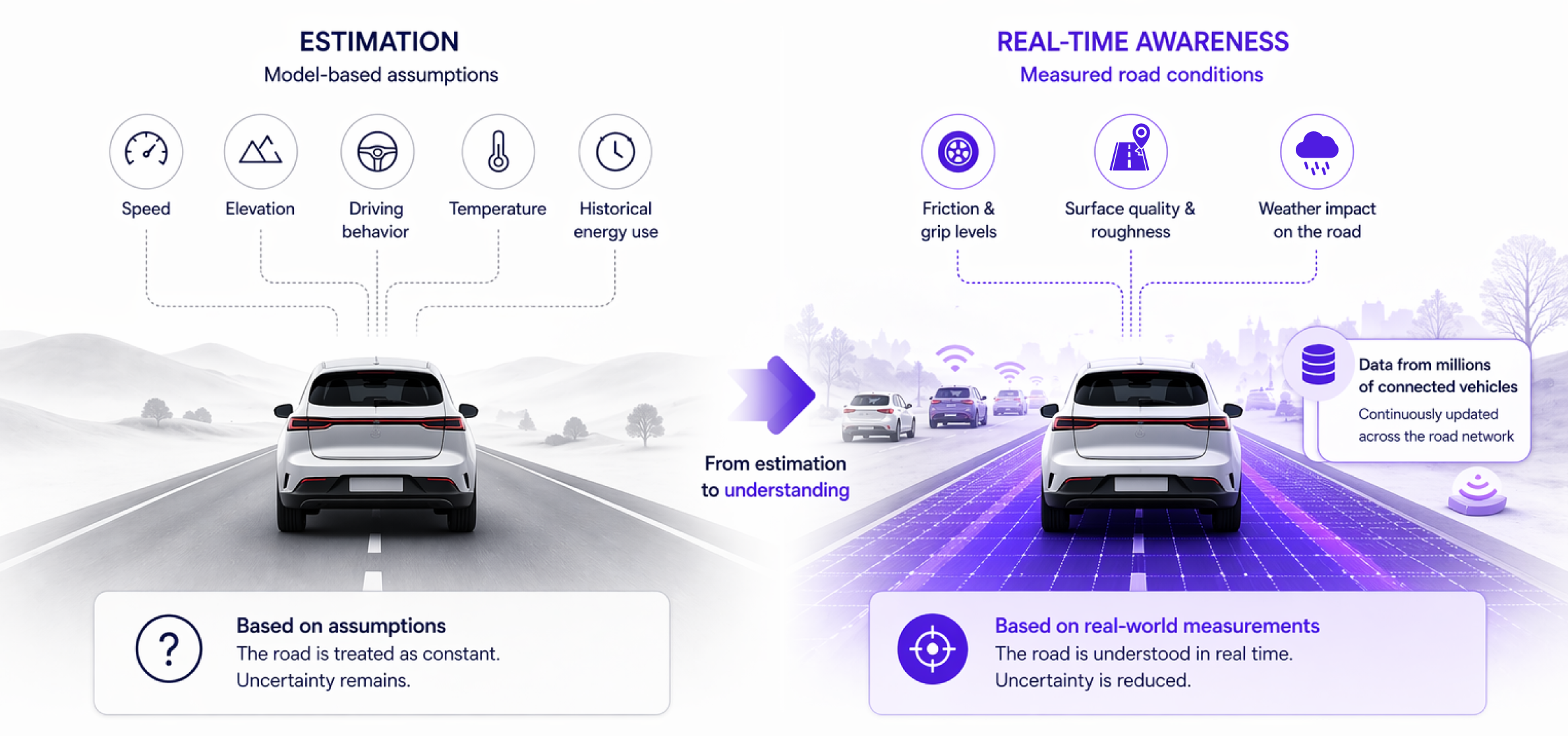
Modern EVs rely on range estimation algorithms that combine speed, elevation, driving behavior, temperature, and historical energy consumption to predict how far the vehicle can travel. This creates a strong baseline, but it is still built on assumptions.
The vehicle may know it is cold. It may adjust for expected efficiency loss. But it often does not know what the road actually feels like under the tires in that exact moment.
That missing layer is where uncertainty comes from.
This is where real-time Road Surface Conditions data changes the equation.
NIRA’s Road Surface Conditions (RSC) provides continuous insight into how the road is behaving, based on direct measurements from connected vehicles. Using data from millions of vehicles, road conditions are captured in high resolution and updated continuously across entire road networks.
At its core, this is based on direct tire-road interaction. The system measures how vehicles actually experience grip and surface roughness, creating a real-world representation of road conditions rather than a modeled estimate.
Instead of treating the road as static, vehicles and systems gain access to real-time insight into:
- Friction and grip levels
- Surface quality and roughness
- The actual impact of weather on the road
This makes it possible to move from estimation to real understanding.
How Road Surface Condition data improves routing and regenerative braking
When this level of road intelligence is integrated into navigation and vehicle systems, optimization becomes significantly more precise.
Routing becomes energy-aware, not just distance-aware
Traditional navigation focuses on the shortest or fastest path. With real-time road surface insight, routing also considers how much energy different road segments will require.
This means vehicles can:
- Avoid segments with high rolling resistance caused by wet, rough, or degraded surfaces
- Prioritize roads with more stable and energy-efficient conditions
- Improve ETA accuracy by reflecting real driving resistance instead of ideal conditions
In practice, the most energy-efficient route is not always the shortest one, but the one with the best surface conditions.
Regenerative braking becomes dynamically optimized
Regenerative braking efficiency depends directly on available grip.
On high-friction surfaces, more energy can be recovered safely. On low-friction surfaces such as ice or wet roads, recovery must be limited to maintain stability.
With real-time grip data, vehicles can:
- Adapt regenerative braking intensity to actual conditions
- Maximize energy recovery when grip allows
- Avoid overly conservative or overly aggressive strategies caused by uncertainty
This enables a more precise balance between safety and efficiency than static calibration can provide.
Energy management aligns with real conditions
With continuous insight into rolling resistance and grip, the vehicle can also adjust how it uses energy in real time.
This includes:
- Adapting torque delivery based on current resistance
- Smoothing acceleration in high-resistance conditions
- Reducing energy losses caused by mismatches between expected and actual road behavior
A more precise way to think about EV performance
As EV adoption grows, expectations are changing. Drivers are no longer only asking how far they can go, they want to trust that the number reflects reality. For fleets, this becomes even more critical, where small efficiency gains scale quickly across vehicles and routes.
What makes the difference is not just better algorithms, but better input.
NIRA’s Road Surface Conditions brings that missing input into the system by turning real-world driving data into continuous road intelligence.
It starts with what actually happens on the road.
- Real-world data from connected vehicles
As vehicles move through the network, tire-road interaction is continuously measured. This provides direct insight into grip levels and road roughness, based on how the vehicle actually experiences the surface. - Road intelligence layers
This data is processed and structured into high-resolution map layers, describing friction, surface quality, and weather impact across the road network. - Seamless system integration
The data is integrated into vehicle systems and applications, enabling continuous, condition-aware decision making.
This creates a live understanding of the road, not as it is assumed to be, but as it actually is.

From estimation to real-world precision
Traditional systems rely on models and averages. They provide a reasonable estimate, but they cannot fully capture how conditions vary across a route. By integrating real-time road surface data, those estimates become grounded in reality.
Range becomes more predictable.
Routing becomes more energy-efficient.
Energy recovery becomes more precise.
What changes is not just performance, but confidence in how that performance is calculated.
The vehicle no longer estimates how the road might behave. It responds to how the road actually behaves, in real time.

.png?width=1024&height=1024&name=Slipperiness%20warning%20(1).png)