System behaviour, performance considerations, and practical implications
Two TPMS architectures addressing the same requirement
Tire Pressure Monitoring Systems are a regulated and integral part of modern vehicle platforms. Their primary purpose is to detect tire pressure loss and inform the driver in time to maintain safety and vehicle performance. Two fundamentally different system architectures are commonly used to fulfill this requirement: direct TPMS (dTPMS) and indirect TPMS (iTPMS).
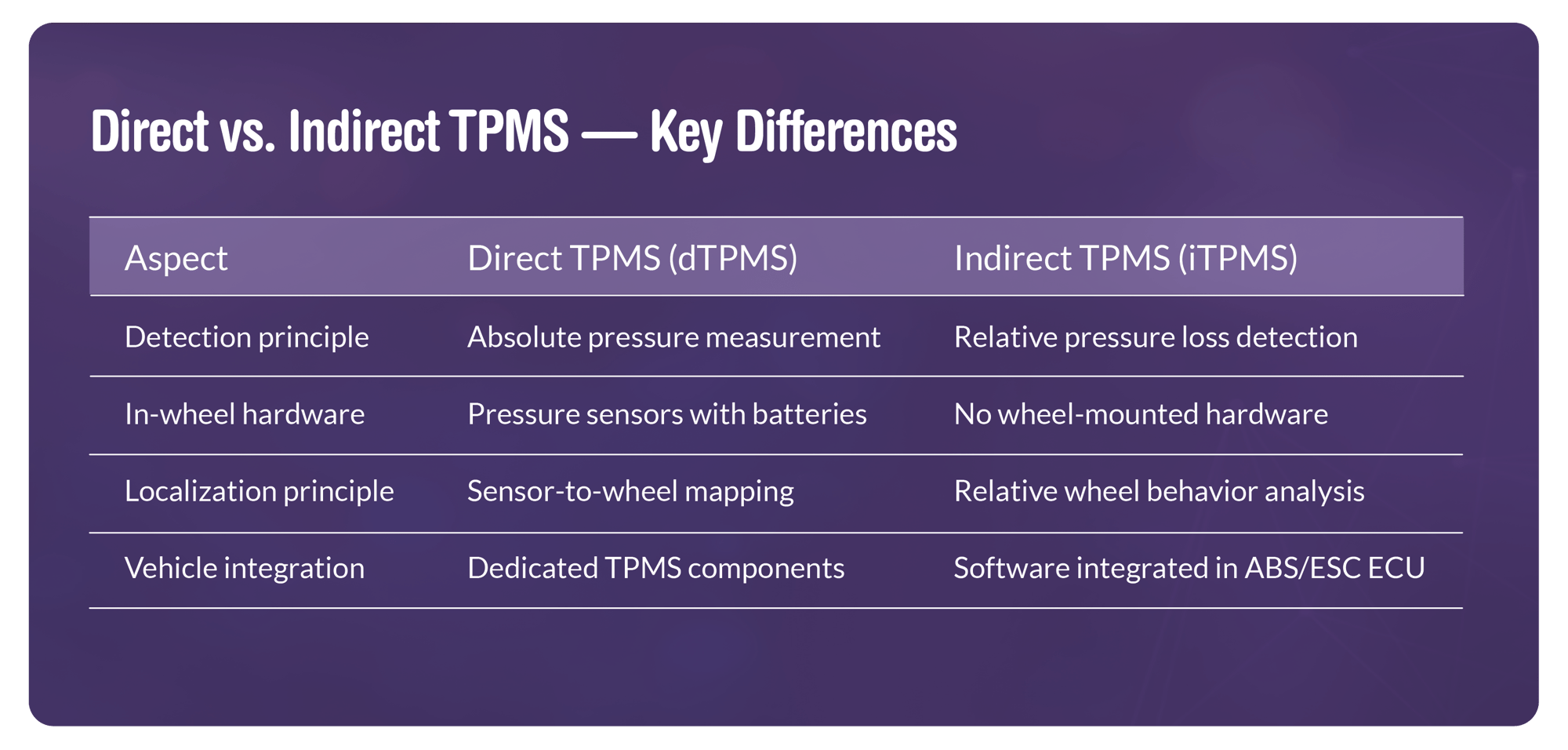
Direct TPMS is based on dedicated pressure sensors installed in each wheel. These sensors measure absolute tire pressure and transmit data wirelessly to the vehicle. System behavior is therefore directly linked to sensor functionality, battery condition, radio communication, sensor identification, and correct handling during production and service.
Indirect TPMS does not measure absolute pressure values. Instead, pressure loss is detected by analyzing wheel behavior and vehicle dynamics using signals already available in the vehicle, typically from the ABS or ESC system. Detection is based on deviations from a learned reference state rather than on absolute measurement.
From a functional and regulatory perspective, both architectures are capable of detecting tire pressure loss and issuing driver warnings within required limits. While both systems address the same regulatory requirement, their differences are best understood at system level, considering detection behavior, operational dependencies, driver interaction, and lifecycle implications rather than sensor technology alone.
Performance considerations – behavior rather than measurement method
Differences in perceived performance between dTPMS and iTPMS are often associated with the distinction between direct measurement and indirect estimation. Historically, this perception favored direct systems, particularly when early indirect TPMS implementations were limited by signal availability and processing capability.
Modern iTPMS implementations operate under different conditions. Performance is no longer primarily determined by whether pressure is measured directly, but by how reliably pressure loss can be detected, localized, and communicated under varying operating conditions.
Wheel differentiation and localization
A common assumption is that reliable localization of pressure loss requires absolute pressure measurement at each wheel. In direct TPMS, localization is inherent, as each sensor is physically associated with a specific wheel.
In indirect TPMS, localization is achieved through continuous comparison of relative wheel behavior. By analyzing differences between all four wheels against a learned reference state, pressure loss can be associated with a specific wheel position.
While indirect TPMS does not provide absolute pressure values per wheel, it fulfills the functional requirement of identifying which wheel deviates from normal behavior and informing the driver accordingly. From a system perspective, localization is achieved through relative analysis rather than sensor placement.
Tire variation, aftermarket tires, and service events
Tire replacement, rotation, and aftermarket variation affect both TPMS architectures, but in different ways.
In direct TPMS, system performance depends on the condition and compatibility of wheel-mounted sensors. Service events therefore introduce dependencies related to sensor handling, installation, programming, and battery status.
Indirect TPMS is independent of in-tire hardware. System behavior is governed by vehicle signals and reference state learning. Modern iTPMS implementations incorporate reset and learning functions that allow the system to adapt to normal tire and service variations without introducing additional components.
As a result, sensitivity to tire changes and service events is shifted from component handling to system-level signal interpretation, reducing reliance on correct hardware handling throughout the vehicle lifecycle.
Detection focus versus absolute pressure values
Absolute pressure values are often associated with accuracy. However, TPMS functionality is defined by the ability to detect pressure loss and communicate abnormal conditions to the driver.
Indirect TPMS focuses on detecting deviations from a learned reference state rather than reporting numerical pressure values. This enables consistent detection of under-inflation events without relying on instantaneous pressure sampling or sensor-based thresholds.
From a functional standpoint, detection capability and consistency are more relevant than absolute pressure precision. Modern iTPMS demonstrates that reliable pressure loss detection can be achieved without direct pressure measurement.
Driver interaction and information presentation
TPMS performance is also influenced by how information is presented to the driver and when abnormal conditions are communicated.
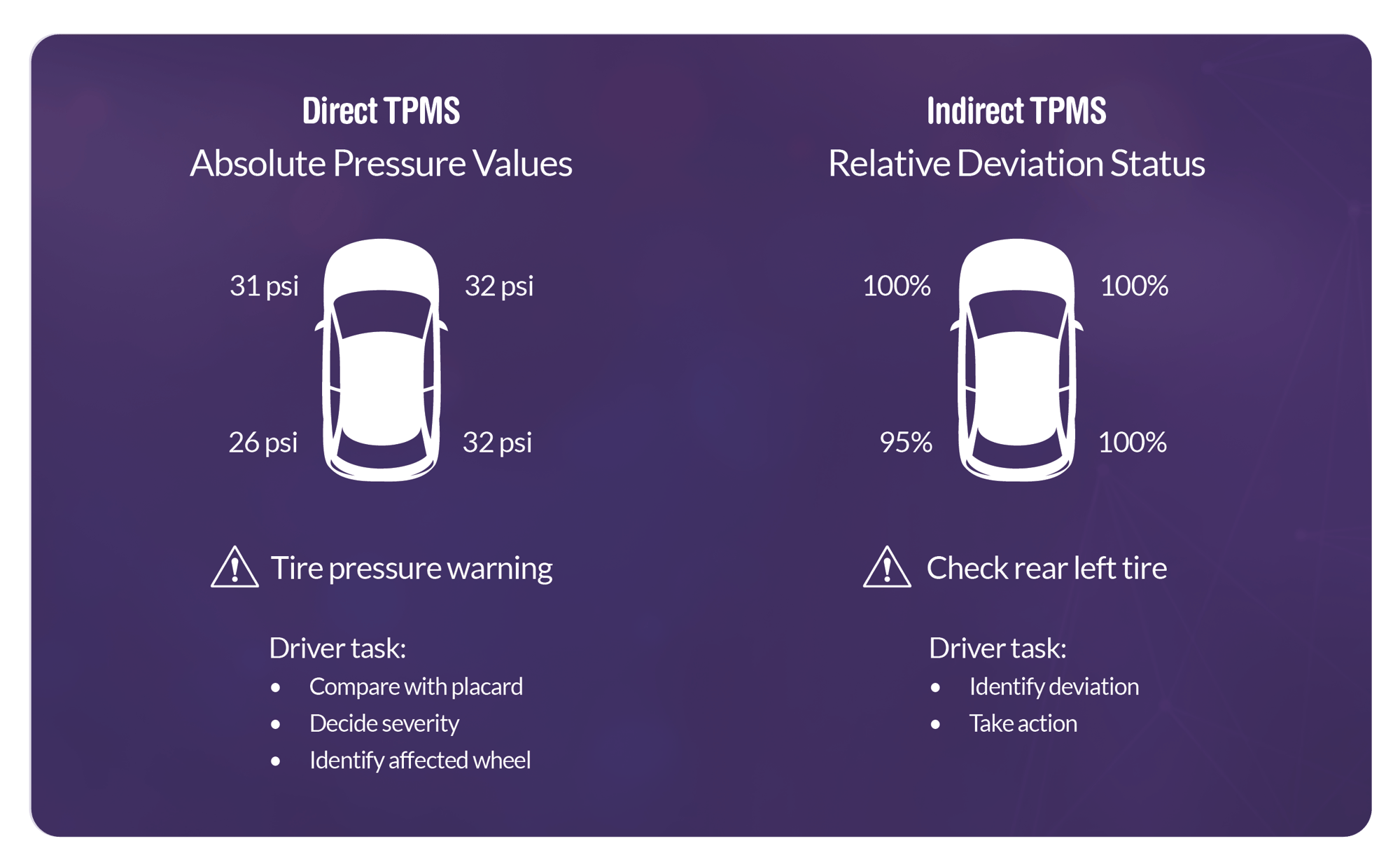
In direct TPMS, pressure information is typically displayed as absolute values. This requires the driver to interpret the data relative to recommended pressure levels, and warnings are often triggered once predefined thresholds are crossed.
Indirect TPMS enables an alternative approach. Because system operation is based on deviation from a reference state, pressure status can be communicated in relative terms. Percentage-based or deviation-based displays indicate how far current conditions deviate from nominal behavior, allowing the driver to assess urgency without interpreting numerical pressure values.
This approach also enables system evaluation at vehicle start-up. By comparing current wheel behavior to the reference state at ignition, pressure deviations can be identified and communicated without waiting for specific driving conditions.
The Tire Pressure Indicator User Experience (TPI UX) exemplifies this principle. Pressure status is presented through a relative interface designed to highlight deviation rather than measurement detail. This user experience is a direct consequence of indirect TPMS operation and reference-based detection.
System complexity and lifecycle implications
Although dTPMS and iTPMS address the same functional requirement, their system architectures differ significantly.
Direct TPMS requires wheel-mounted sensors, RF communication components, and associated software. These elements introduce dependencies related to supply chain, end-of-line programming, service handling, and component aging over the vehicle lifetime.
Indirect TPMS is implemented as embedded software within existing vehicle control units, typically the ABS or ESC ECU. The absence of in-tire hardware reduces component count and eliminates dependencies related to sensor batteries, RF communication, and wheel-specific components.
Over the vehicle lifetime, robustness is influenced not only by detection logic but also by how system performance is affected by component aging, service variability, and software evolution. Direct TPMS relies on distributed hardware elements with finite battery life and handling sensitivity, while indirect TPMS behavior is primarily governed by software and signal integrity within existing control units. These differences influence long-term consistency and operational predictability rather than immediate detection capability.
When detection performance is comparable, differences in system complexity and lifecycle behavior become increasingly relevant. Indirect TPMS provides a simplified system architecture by relying on existing vehicle signals and software-based functionality.
Summary
Direct and indirect TPMS represent two established approaches to tire pressure monitoring. Both systems are capable of detecting pressure loss and informing the driver within regulatory requirements.
Advances in system integration and signal processing have significantly improved the robustness of modern indirect TPMS. As a result, evaluation criteria extend beyond measurement method to include system behavior, consistency across usage conditions, driver information clarity, and lifecycle complexity.
As vehicle platforms increasingly prioritize software integration and system efficiency, understanding these architectural trade-offs becomes critical for informed TPMS selection.