

Industry
AutomotiveThe Challenge
Meeting global TPMS legislation across a highly diverse vehicle portfolio, from premium models to high-volume platforms, while controlling cost, complexity, and long-term scalability.
The Results
A software-only tire safety solution deployed across millions of vehicles, delivering global TPMS compliance for more than 15 years, with advanced safety features introduced first in premium vehicles and later scaled across platforms.
Products Used
Tire Pressure Indicator (TPI), Loose Wheel Indicator (LWI)The Challenge
One tire safety strategy for many brands and platforms
For a large automotive group spanning everything from premium vehicles to high volume passenger cars, tire safety is a complex challenge.
Different brands, platforms, and markets mean varying cost targets, vehicle architectures, and regulatory requirements. The group needed a single, scalable approach to TPMS compliance that could be deployed globally, without adding hardware cost or increasing system complexity.
At the same time, there was a clear ambition to go beyond compliance and introduce additional safety functions where they added the most value, starting with premium vehicles and later expanding across the broader portfolio.
The Solution
A software platform that scales with the portfolio
The group selected NIRA Dynamics’ Tire Pressure Indicator (TPI) as a software-only solution to meet worldwide TPMS legislation across its vehicle lineup.
The key realization was that TPMS compliance could be achieved using existing vehicle sensors, removing the need for dedicated hardware and enabling a cost-efficient rollout across both premium and high-volume models.
Building on this foundation, the group later introduced Loose Wheel Indicator (LWI), initially in higher-end vehicles, as an additional safety feature. LWI addresses a real-world risk scenario: loose wheels caused by human error during tire changes. By leveraging the same software architecture, the function could be added without redesigning the vehicle platform.
Ease of collaboration, proven reliability in production, and the ability to scale features selectively across brands and segments were decisive factors in choosing NIRA as a long-term partner.
The Results
Proven reliability at group scale
The result is a robust, worry-free tire safety system that has been running in production for more than 15 years across a broad range of vehicles.
TPI delivers consistent TPMS performance independent of tire type, vehicle model, or market, making it ideal for large-scale deployment. LWI adds an extra layer of safety where it matters most, starting in premium vehicles and creating a clear path for future expansion.
Together, the solutions reduce hardware dependency, simplify vehicle architectures, and support a unified tire safety strategy across the entire group.
Key Impact
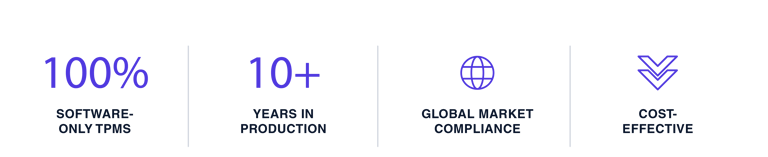
- Software-only TPMS compliance across global markets
- Significant reduction in hardware and system cost
- Scalable deployment from premium to high-volume vehicles
- Additional safety layer through loose wheel detection
- Proven reliability over more than a decade in production
- Flexible rollout aligned with brand and segment strategies
“NIRA’s software-based approach gives a reliable and scalable tire safety solution across a very diverse vehicle portfolio. It allows meeting regulatory requirements efficiently while adding safety features where they deliver the most value.”
Long-Term Value
By establishing a common, software-based foundation for tire safety, the group has created a future-proof solution that supports long-term cost control, platform reuse, and software-defined vehicle strategies.
The approach enables selective feature rollout — introducing advanced safety functions in premium vehicles first, while maintaining a consistent and efficient baseline across high-volume platforms. This flexibility ensures that tire safety evolves in step with the group’s broader vehicle and software roadmap.